
 Han
Han
The Base Cabin is a contemporary tiny house on wheels available in Australia—and it might just make its way across the pond. The Melbourne-based company released its trailer in March and is looking into international shipping, as they have had plenty of overseas inquiries.

For $99,990, the turnkey cabin has everything you need to hit the road. And for $59,990, you can get a shell to customize yourself. You also can choose from several off-grid and design upgrades.

The 146-square-foot space is designed as a couple’s getaway. It can easily accommodate more than two with a daybed in the living area, and a loft can be installed for additional space.
A-Frame Cabin Aesthetics
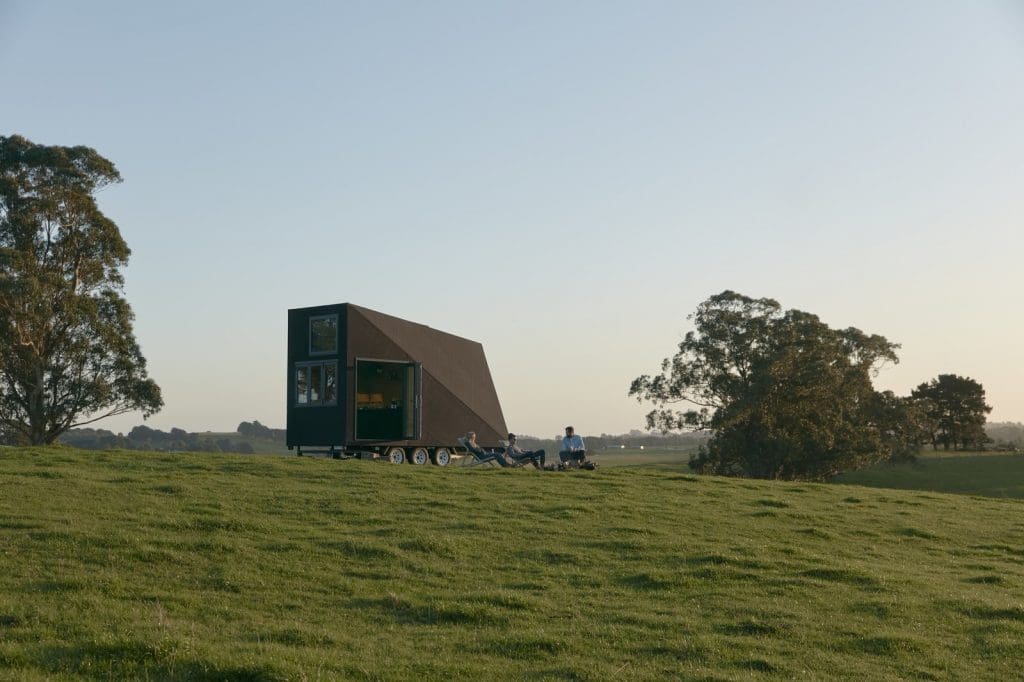
The tiny home on wheels was designed by the Victoria-based architecture and design firm Studio Edwards. The designers drew their inspiration from classic Airstream trailers and the geometric design of A-frame cabins.
“Our brief to [Studio Edwards] was to come up with something completely different in the tiny cabin space,” says Base Cabin co-founder Ryan McCormack. “When you think of that iconic A-frame design, it conjures up memories of camping as a kid under older-style tents and bivouacs.”
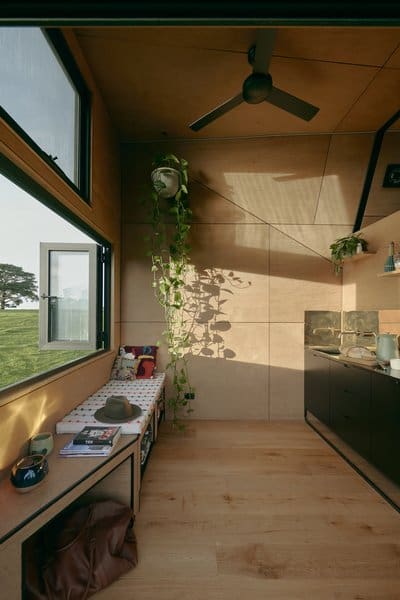
Base Cabin’s interior is clad in ForestOne marine ply, chosen for its warmth and richness. “It’s also the most practical choice, as it can take moisture and wear and tear without having to seal it, where you can lose some of that beautiful rawness,” McCormack says.
The material palette makes the interior feel luxurious and dynamic, with cedar and terrazzo floors, brass accents, concrete, tile, and black timber.

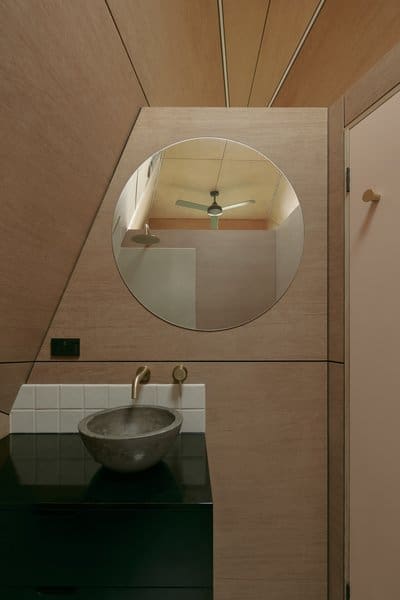
The bathroom is located to the side by the kitchen to create a roomy corridor, allowing for better flow from the living area to the bedroom.
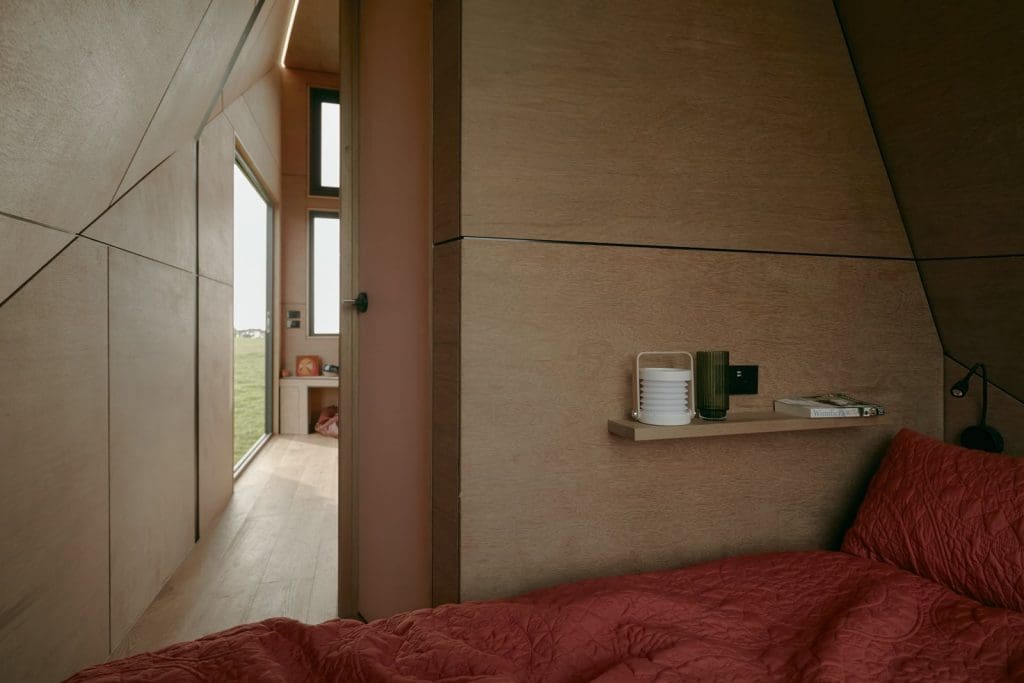
“We wanted the sleeping area to be toward the A-frame end of the cabin, as that large fixed window really captures the outside world, and you can lay in bed and take everything in whilst reading—or just enjoying the views,” McCormack says. “It also made sense to have the living areas to the rear, where you experience the real internal heights.”

Another way the designers played with the concept of space was by having the ceilings stretch to almost 11 feet high. Their lofty nature makes the Base Cabin feel more prominent, especially with the center skylight drawing the eye upward.
Plug and Play Design
The windows are positioned to help create a larger sense of space. A perfect way to connect people with the great outdoors. Some windows act as spotlights, highlighting specific features with natural light. For instance, the skylight in the bathroom welcomes natural light in the center of the cabin, and it can be opened to allow natural venting.
The windows and doors are doubled glazed to protect occupants from the outdoor elements. This is to reduce Base Cabin’s reliance on powered lighting and cooling.
“If you think of a wet suit material, that’s effectively it,” McCormack says.
The steel-frame trailer can be towed by most SUVs and pickup trucks. Its A-frame-inspired trailer’s angular design gives it a more aerodynamic quality than boxy tiny homes on wheels.

Base Cabin’s “plug and play” design allows it to run off the primary power source. When off the grid, it’s powered by a generator, solar power, batteries, and an inverter.


Comments
Loading…